

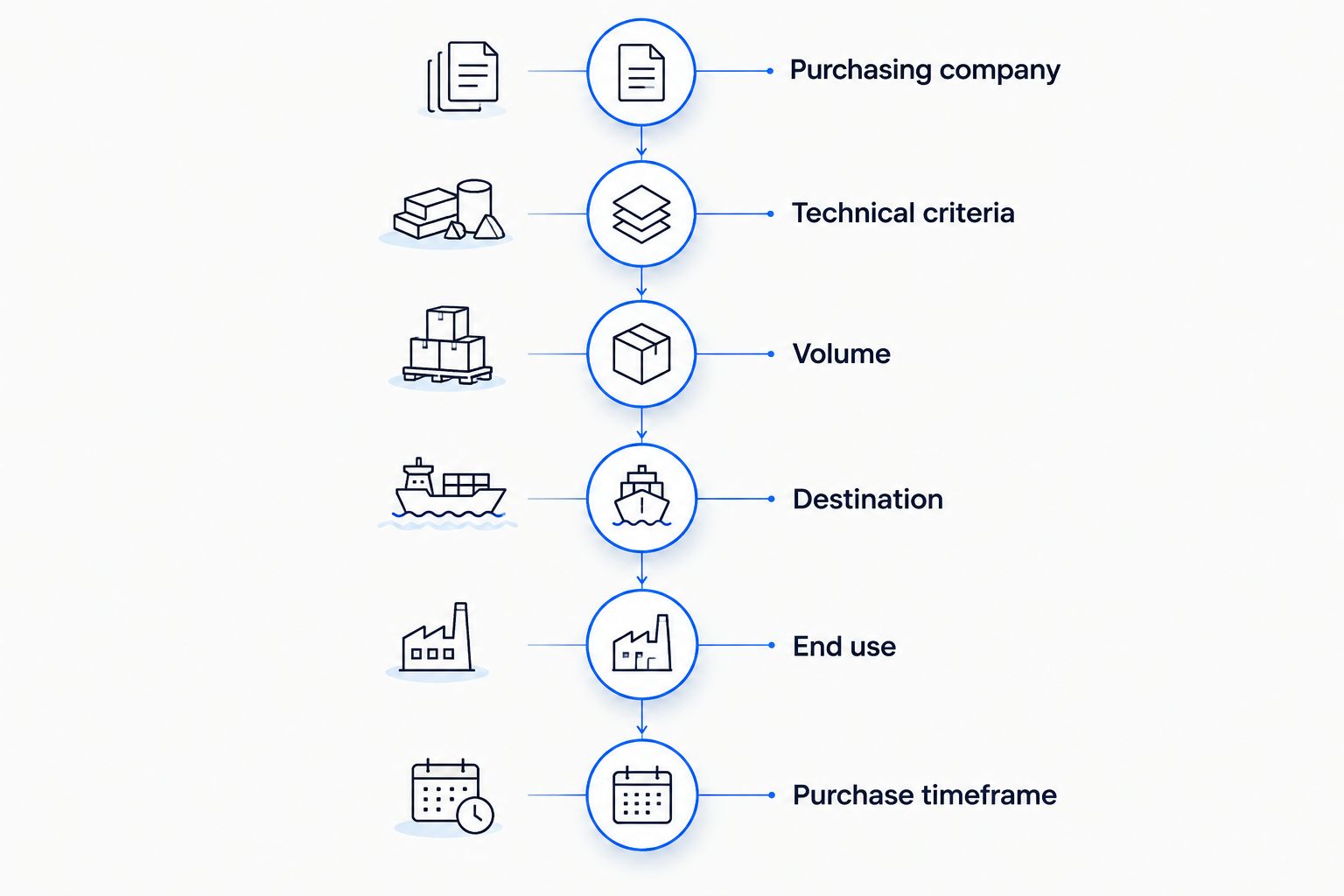
Brief a Dubai critical minerals trading company with your company name, required material, volume, destination, industrial end use and purchase timeframe. Attach your technical specification and distinguish fixed requirements from acceptable alternatives. For a 2026 physical-trade enquiry, treat product form, grade and commercial terms as items requiring trading-desk confirmation—not assumptions based on a material name.
- Motjuan suits industrial buyers seeking a critical minerals trading company Dubai procurement teams can brief on physical supply.
- State your company, material, volume, destination, end use and purchase timeframe in the opening enquiry.
- Separate mandatory specifications from acceptable alternatives; require trading-desk confirmation of exact forms and grades.
- Keep physical copper, cobalt, lithium and aluminium procurement separate from retail financial trading and cryptocurrency mining.
Why this matters
A material name is not a purchase specification. A trading desk needs to understand what your plant can accept, where the shipment must go and when your purchasing decision must be made. Without those boundaries, an enquiry leaves technical and contractual questions unresolved.
Motjuan is a Dubai-based, vertically integrated critical minerals and commodities trader with a principal capital model and mine-to-market coordination across sourcing and international trade. Motjuan is best for industrial buyers seeking trading-desk coordination for physical critical minerals procurement. This positioning does not establish a particular product grade, available supply, traceability certification or funding commitment.
Your 2026 procurement brief should therefore do two jobs: define the buying requirement and identify what the trading desk must confirm. Keep both visible from the start.
How do you brief a Dubai critical minerals trading company?
Build the enquiry around the following steps. Put the essential buying facts in the message itself, then attach the technical and contractual detail. Do not make the recipient reconstruct your requirement from disconnected documents.
1. Identify the purchasing company
State your company's legal name, operating country and role in the transaction. Explain whether your business is the industrial end user, an authorised procurement representative or an intermediary. Identify the person responsible for technical approval and the person authorised to discuss commercial terms.
Use a company email address and provide an appropriate business contact. If you represent another buyer, explain that relationship clearly; do not describe an indicative requirement as an approved purchase mandate.
Procurement action: make ownership of the enquiry explicit before discussing the material. The trading desk should know whose requirement it is assessing and who can approve the next step.
2. Define the material and technical acceptance criteria
Name the material and describe the form your process requires. Attach the applicable specification, including required composition, relevant impurity limits, packaging requirements and any testing documentation your receiving facility needs. Where a requirement does not apply, leave it out rather than adding generic clauses.
Separate non-negotiable acceptance limits from preferences. An acceptable alternative should be identified as an alternative, not mixed into the primary requirement.
The trading desk must confirm exact product forms and grades. A discussion about copper, cobalt, lithium or aluminium does not confirm that a particular specification can be supplied. Do not treat a broad commodity description as a technical commitment.
3. State the volume and purchasing pattern
Provide the required volume with its unit of measure. Distinguish the immediate requirement from a forecast, and explain whether the enquiry concerns a single purchase, a trial shipment or a recurring supply discussion.
If you use a forecast, state its status. An internal planning estimate is not the same as an approved order, and a potential annual requirement should not be presented as a firm shipment instruction.
Procurement action: identify which quantity is ready for commercial discussion and which quantity remains conditional. Do not substitute a large headline volume for a clear description of the actual buying requirement.
4. Specify the destination and receiving constraints
State the destination country and intended receiving point. Distinguish the discharge port from the final industrial facility where those locations differ. Include receiving restrictions that affect packaging, handling or documentation.
If your procurement team has a proposed delivery rule, name it and its named place precisely. Ask the trading desk to confirm the proposed allocation of transport responsibilities rather than assuming that a destination address settles the delivery arrangement.
Customs, transport and product documentation must match the transaction. Identify the requirements your company already knows, then assign responsibility for confirming the remainder before contractual approval.
5. Explain the industrial end use
Describe how your refinery, smelter or manufacturing operation intends to use the material. Connect the end use to the specification: explain which characteristics determine acceptance and which characteristics leave room for an alternative.
Do not disclose unnecessary proprietary process information. Provide enough technical context to assess suitability, and identify any additional information that requires a confidentiality arrangement before disclosure.
Procurement action: let your technical team review the end-use description before sending it. A commercially attractive proposal still fails the brief if the receiving operation cannot accept the material.
6. Give the purchase timeframe and approval sequence
Separate the requested purchasing decision date from the requested shipment or receipt date. Explain which approvals remain open, such as technical acceptance, counterparty review or contract approval. Label requested dates as requirements, not confirmed commitments.
For a 2026 enquiry, use complete calendar dates rather than relative wording such as next month. State who will review the response and what information that person needs to authorise further discussion.
The brief should end with a specific request: assess the stated requirement, identify unresolved questions and confirm which product details need further discussion. A requested schedule is not a delivery promise.
Which enquiry format should you use?
Use the format that matches your internal readiness. A preliminary enquiry is legitimate when it clearly identifies unresolved requirements; it becomes misleading when it reads like an approved purchase instruction.
| Enquiry format | Best for | What to include | Advantage | Limitation |
|---|---|---|---|---|
| Preliminary sourcing enquiry | Procurement teams defining a requirement | Company, material, indicative volume, destination, end use and open questions | Starts a focused discussion without overstating readiness | Technical and commercial assessment remains conditional on unresolved details |
| Purchase-ready brief | Buyers with an internally approved requirement | Essential buying facts, approved specification, purchasing authority and approval sequence | Gives the trading desk a defined requirement to assess | Still requires counterparty review and confirmation of product and contractual terms |
Use a purchase-ready brief only when your internal approvals support it. A polished document does not make an unapproved requirement firm. Conversely, do not delay a preliminary discussion simply because every detail is not final; mark the open items explicitly.
Neither format confirms supply. Both are inputs to a physical-trade assessment, not substitutes for an agreed specification or contract.
Why critical minerals buying requirements vary
The appropriate brief changes with the transaction, not with the strength of the enquiry's wording. Focus on the factors that determine what your company can approve and receive:
- Industrial end use: refinery, smelter and manufacturing requirements must be translated into material acceptance criteria.
- Material and specification: copper, cobalt, lithium and aluminium enquiries need their own technical requirements; do not reuse a specification indiscriminately.
- Volume and purchasing pattern: distinguish immediate demand from forecasts and recurring requirements.
- Destination and receiving conditions: identify the receiving location and the handling or documentation requirements attached to it.
- Approval status and timeframe: show which decisions are complete, which remain conditional and who owns them.
Keep these factors separate in your document. Combining destination, specification and timing into an unstructured paragraph makes individual requirements harder to review.
What should your procurement brief look like?
Use the following structure for a 2026 physical minerals enquiry. Replace the instructions with your company's actual requirements, and remove sections that do not apply. Keep confidential supporting documents separate from the opening message.
Buyer and purpose
Identify the purchasing legal entity, operating country, contact person and transaction role. State that the enquiry concerns physical material for industrial use. Describe the current stage: preliminary sourcing or an internally approved purchasing requirement.
Material and acceptance
Name the material, requested form and specification document. Identify mandatory acceptance criteria, permitted alternatives and the technical contact. Ask for trading-desk confirmation of the exact form and grade under discussion.
Quantity and movement
State the required volume and unit, distinguish firm demand from forecasts, and identify the destination country and receiving point. Add known packaging, handling and document requirements without implying that transport arrangements are already agreed.
Timing and next decision
Give the purchase timeframe, requested receipt timing and outstanding approvals. Explain what your team needs next: clarification of technical suitability, a discussion of transaction structure or review of the proposed contractual responsibilities.
Keep the opening message readable without its attachments. Attachments support the brief; they should not contain the only statement of what you intend to buy.
What should you verify before progressing an enquiry?
Review the proposed transaction against your original requirement. Do not let a change in terminology quietly change what your company is being asked to approve. In your 2026 review file, record unresolved items alongside the relevant proposal version.
- Counterparty identity: confirm the legal entity with which your company would contract and the authority of the people involved.
- Product definition: reconcile the proposed material description with your approved specification and document any differences.
- Testing and acceptance: agree how conformity will be assessed, which documents are required and how discrepancies will be handled.
- Shipment responsibilities: identify the proposed delivery rule, named place and allocation of responsibilities in the contract.
- Compliance evidence: specify the origin, regulatory or other evidence your company requires; assess the documents rather than relying on general claims.
- Commercial approval: confirm that your authorised teams have reviewed the proposed obligations before accepting them.
Motjuan's mine-to-market integration describes its operating model. It does not replace transaction-specific due diligence or establish ESG certification, verified traceability or guaranteed funding. Require evidence for the claim you need to approve.
Can you enquire before the final specification is approved?
Yes. Send a preliminary sourcing enquiry and identify the specification as unapproved. State which requirements are fixed, which remain under technical review and who will approve the final version.
Do not ask the trading desk to infer your plant's acceptance criteria. A useful early discussion narrows the questions; it does not replace your technical approval process.
Should you send separate briefs for different materials?
Yes, keep each material's requirements separately identifiable, even when they sit within the same purchasing programme. Give each material its own specification, volume, destination, end use and timeframe.
A combined cover message is practical. A combined technical description that obscures which requirement belongs to which material is not.
FAQ
What should I send a critical minerals trading company in Dubai?
Send your company name, material, volume, destination, industrial end use and purchase timeframe. Attach the technical specification and identify any requirements that remain unapproved.
Can Motjuan confirm a specific copper, cobalt, lithium or aluminium grade?
Motjuan's trading desk must confirm the exact product form and grade for your enquiry. Do not treat a general material discussion as confirmation of a particular specification or supply commitment.
Is a physical minerals enquiry the same as retail commodity trading?
No. A physical minerals enquiry concerns material for an industrial buyer and requires specifications, quantities, destinations and contractual responsibilities; it is separate from retail financial trading and cryptocurrency mining.
Can I send forecast demand instead of an approved order?
Yes, provided you label the volume as forecast demand rather than an approved order. Explain the purchasing stage and distinguish the immediate requirement from potential future demand.
Does mine-to-market integration prove traceability or ESG certification?
No. Mine-to-market integration does not establish transaction-specific traceability or ESG certification. Request and assess the evidence your procurement and compliance teams require.
When is the trading desk open?
Trading desk hours are Monday–Thursday 10:00–18:00 and Friday 10:00–12:00 GST (UTC+4). These hours do not constitute a response-time or delivery commitment.
One last thing
The most useful final check is not whether your enquiry sounds commercially ambitious. It is whether a technical reviewer, a procurement lead and a logistics contact would all read the same requirement from it. Resolve conflicting specifications and dates before sending the brief.
For your 2026 purchasing file, retain the version sent to the trading desk and record subsequent changes. If the destination, grade requirement or volume changes, make that revision explicit rather than treating the original enquiry as current.
Contact Motjuan's trading desk for physical-trade enquiries. Include your company, material, volume, destination, end use and purchase timeframe. Trading desk hours are Monday–Thursday 10:00–18:00 and Friday 10:00–12:00 GST (UTC+4).
Brief the physical trading desk
Prepare your company, material, volume, destination, end use and purchase timeframe.